with border 2 Now in theaters, the scale and realism of its action sequences has become one of the most talked-about aspects of the film. had an exclusive conversation with IHNSProducer Bhushan Kumar and director Anurag Singh talked about the logistical, technical and creative challenges involved in setting up large-scale battle sequences without relying on green screens.
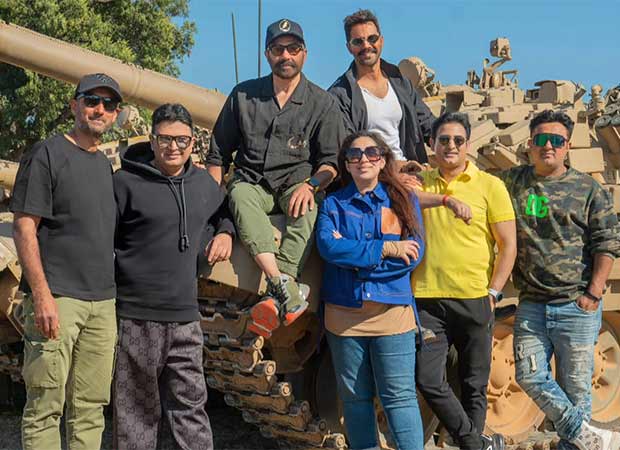
Exclusive: Border 2 director Anurag Singh breaks down the “no green screen” approach for the action war film; Explains the challenges of shooting at real locations
Director Anurag Singh revealed that one of the biggest challenges was shooting entirely on real locations rather than in a controlled studio environment. The film was shot in locations such as Dehradun and Jhansi, often in extreme weather conditions, with a large crew and complex staging.
He said, “Shoot-wise, the most challenging were the action sequences. Because the scale increases. Your team of three-four people sitting there becomes a unit of 400-500 people. Because the scale increases. You are shooting in real locations, not on a green screen – in places like Dehradun or Jhansi. There is freezing cold or unbearable heat, and you have to do action from morning till evening.”
According to Singh, the fight scenes require a level of coordination that goes far beyond standard action choreography. Each shot involves multiple departments working together – from explosives and stunts to crowd movement and actor positioning – leaving little margin for error.
“There are so many elements to action. A lot of things have to come together. It has to work like clockwork to land a shot correctly. You’re detonating; you have to place the explosives. How will people react, which actor will be at what distance, how much fire will come out – you know, all these people are working together… and this is war. It’s not just two guys in action; there’s over 500 people running behind them, firing. The scale of this is all happening, so taking action was quite difficult,” he added.
Another significant challenge was dealing with elements that could not be practically recreated, especially air combat. Singh said that the film aimed for realism, but some components such as fighter planes had to be created using visual effects – requiring careful integration to maintain believability.
“The other difficult part was that some of the things are not available today. If you talk about planes, planes would obviously be VFX. You know, it’s not like you have actual planes that you can fly and shoot, so it has to be VFX. So now, how do you bring it up to a certain level and how do you translate it to the screen – all those were very challenging things,” he said.
Despite the technical demands, Singh stressed that emotional authenticity remained central to the action design. Sequences like Varun Dhawan’s trench combat and Sunny Deol’s tank battles were planned to feel raw and grounded, without allowing the character-driven moments to dominate.
He explained that the strong performances help maintain emotional weight even in large-scale set pieces. “Emotions, what happens is, if you have cast good actors and your scenes are well written, you know they will translate,” Singh said, “We were talking about actors – just now we talked about Ahan (Shetty) he is a very honest guy, we know Varun (Dhawan) is a very good actor, we talked about Sunny (Deol) sir who is a very emotional person, and Diljit. (Dosanjh) Paaji whose connection with the people is also from the heart.”
Produced by Bhushan Kumar, border 2 The legacy of the 1997 classic is carried forward by combining sweeping action with a grounded emotional story. As the producers explain, the aim was not just to recreate the war on a larger canvas, but to ensure that every explosion, movement and visual effect presented the human stories at the center of the film.